30.4.05

Statewatch: monitoring civil liberties in the EU
Statewatch: monitoring civil liberties in the EU (and around the world for that matter, it is, after all, a "Small World" (tm))
20 April, 2005: Global coalition launch report and international surveillance campaign: London - Statewatch, with partner organisations the American Civil Liberties Union (ACLU), Focus on the Global South, Friends Committee (US) and the International Civil Liberties Monitoring Group (Canada) today publishes an in-depth report on "The emergence of a global infrastructure for registration and surveillance". With the support of around 100 civil liberties groups and NGOs from across the world, the report is backed by the launch of the International Campaign Against Mass Surveillance (ICAMS), calling on all national governments and intergovernmental organisations to turn away from anti-terrorism efforts that are oriented around mass surveillance:
- 1. Press release (pdf)
- 2. Executive Summary (English, pdf) French (link)
- 3. Full report (pdf)
- 4. Declaration (English, pdf) French (link) Spanish (link) Dutch (link)
- 5. List supporting organisations
- 6. Endorse the Declaration - sign-up (link)
Tony Bunyan, Director of Statewatch, said: "We are very pleased to be joining with so many civil liberties groups from around the world to oppose the introduction of mass surveillance on a global basis. There is a real danger that in trying to watch everyone you are actually watching no-one"
Contrary Brin: A guest Commentator on the Modernist Rift
Contrary Brin: A guest Commentator on the Modernist Rift
David has been developing a theme at some length concerning the ongoing war of romaticism vs modernism. In April 28th's post he has a guest commentator, Frederick Turner who has this to say:
I believe that the rift between the sciences and the humanities is profoundly dangerous both intellectually and culturally, leading to deep errors of understanding and unwitting crimes. Certainly at the time it seemed the only defense against what looked like a brutal pragmatism in personal relationships and a ruthless historicism in international realpolitik, where the victors in both cases would write history. But the apparent cure--the cordon sanitaire between science and the humanities--had side effects perhaps worse still. Let us look briefly at the history of those key humanistic ideas: freedom in moral action and originality in art.
To be free one must have free will. Will became the core concept of nineteenth century moral philosophy. It was will or intentionality that set us apart from brute nature. But what was the direction of will? It could only be the extension of its own field of action, since any focussing down on a specific object in the world would enslave it to the deterministic motivations of physicality. "Extension of the field of action" is nicely glossed by the word "power": so "Will" now became "the Will to Power". Thus power eventually became the key idea of the Humanities, as it remains today in its Foucauldian, Feminist, Postcolonialist, Lacanian, and Neomarxist versions. Strangely, our original enterprise, which was to delineate an alternative humanistic world to the deterministic realm of physical forces, has logically morphed itself into the very enemy it was designed to escape.
Power, whether expressed in oppressive violence by a reactionary elite, revolutionary acts by the disenfranchised, or legal sanctions by an enlightened ruling group, is the same thing as physical force: politically it means that you can send men with guns to make people do what you want. If beauty has been culturally relativized out of existence (which is indeed the result of avant-garde theory) and if logical reasoning is, as part of the regnant regime of power and knowledge, no more than the linguistic property of the oppressor, the only way to persuade people is through force.
...Thus the humanities, when cut off from nature, ended up not only looking exactly like the brutal world they hoped to transcend, but also trapped in the gradual entropic heat-death of the physical universe.
I have _major_ problems with that conclusion. To me it is an extreme generalization, illogical and not backed even by the limited amount of very selective evidence presented. To make another generalization, I'd say that too much thought is being presented in a supposedly rigourous manner but completely lacking in objective logic.
29.4.05
28.4.05
Information wants to be free - in context.
That was Stewart Brand's creation, originally uttered in 1984, at the
first Hackers' Conference, and printed in a report in the May 1985 "Whole
Earth Review." It later turned up in his book, "The Media Lab: Inventing
the Future at MIT," published in 1987:
"Information Wants To Be Free. Information also wants to be expensive.
Information wants to be free because it has become so cheap to distribute,
copy, and recombine---too cheap to meter. It wants to be expensive because
it can be immeasurably valuable to the recipient. That tension will not go
away. It leads to endless wrenching debate about price, copyright,
'intellectual property', the moral rightness of casual distribution,
because each round of new devices makes the tension worse, not better."
27.4.05
Get Fuzzy Censorship
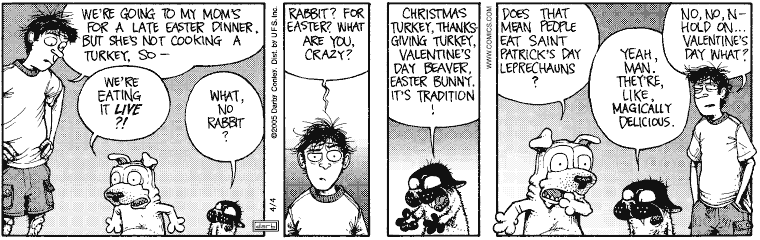
On April fourth, Get Fuzzy was released in 2 versions. I present both for your edutainment. First we have the censored version :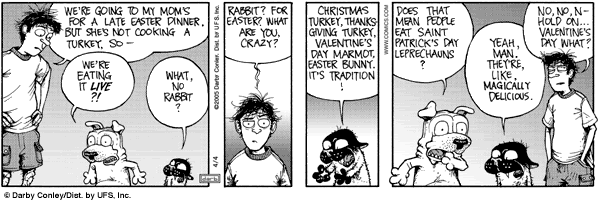
And now, the funny version :)
BBC NEWS | World | Americas | US 'conceals high terror figures'
BBC NEWS | World | Americas | US 'conceals high terror figures'
Last year's original report said there had been a total of 190 terror acts around the world in 2003 - pointing to a steady decrease over three years.
The administration seized on this and other numbers as proof that its war on terror was succeeding.
In the revised report the department said there had in fact been 208 attacks - an increase from 2004.
Then-Secretary of State Colin Powell said there had been no attempt to deceive people, and blamed clerical and administrative errors.
Snails are faster than ADSL
Following on from some pioneering work done in Norway, scientists in Israel have published research done on a SNAil based carrier Protocol
The following table, summarize the results:
| Technology | Kbps |
|---|---|
| V.34 modem | 28.8 |
| ISDN | 128 |
| ADSL | 1500 |
| Pigeons | 2270 |
| SNAP | 37,000 |
Please note all measured times were recorded by an observer on the ground. If measured by the moving snail itself, times would have been a bit shorter, according to Einstein's relativity theory, resulting in slightly greater bps rates.
26.4.05
Canadian charter of rights and freedoms
For your records - Canadian charter of rights and freedoms: "Whereas Canada is founded upon principles that recognize the supremacy of God"
And FYI: the most infamous stain on our character.
25.4.05
The Open Source Political Challenge
Some interesting generalizations about open source vs closed source in politics where "open source" is a popular movement and closed source is a corporate or PAC driven agenda.
Playing partisan politics with international telecom standards
The State Department has traditionally put together a list of industry representatives for these meetings, and anyone in the U.S. telecom industry who had the requisite expertise and wanted to go was generally given a slot, say past participants. Only after the start of Bush's second term did a political litmus test emerge, industry sources say.
The White House admits as much: "We wanted people who would represent the Administration positively, and--call us nutty--it seemed like those who wanted to kick this Administration out of town last November would have some difficulty doing that," says White House spokesman Trent Duffy.
Well, I won't call you "nutty", but I will call you a filthy partisan bribe-seeking whore. Good enough? (No offense intended to the hard working sisters in the International Order of Manual Release Technicians)
24.4.05
Managing spreadsheet fraud | The Register
According to both PricewaterhouseCoopers and KPMG, more than 90 per cent of corporate spreadsheets have material errors in them. Worse, estimates suggest that such errors costs between $10,000 and $100,000 per error per month. Let's take the Fortune 500 and let's suppose that each of these companies has just 10 (a pitifully small number) spreadsheets of corporate significance. Then nine have errors. Let's be circumspect and suppose that each has only one error and that it is spotted within three months (wildly optimistic); then each error costs $165,000 on average.
So how much money is the Fortune 500 wasting annually? It is a simple sum: $165,000 times 9 times 500. That amounts to just shy of three quarters of a billion dollars. And is that anywhere near realistic? No. It is probably safe to say that corporate America, for example, loses in excess of $10bn annually through the misuse and abuse of spreadsheets. That's a big number: it suggests a problem worth managing.
Subscribe to:
Posts (Atom)


